


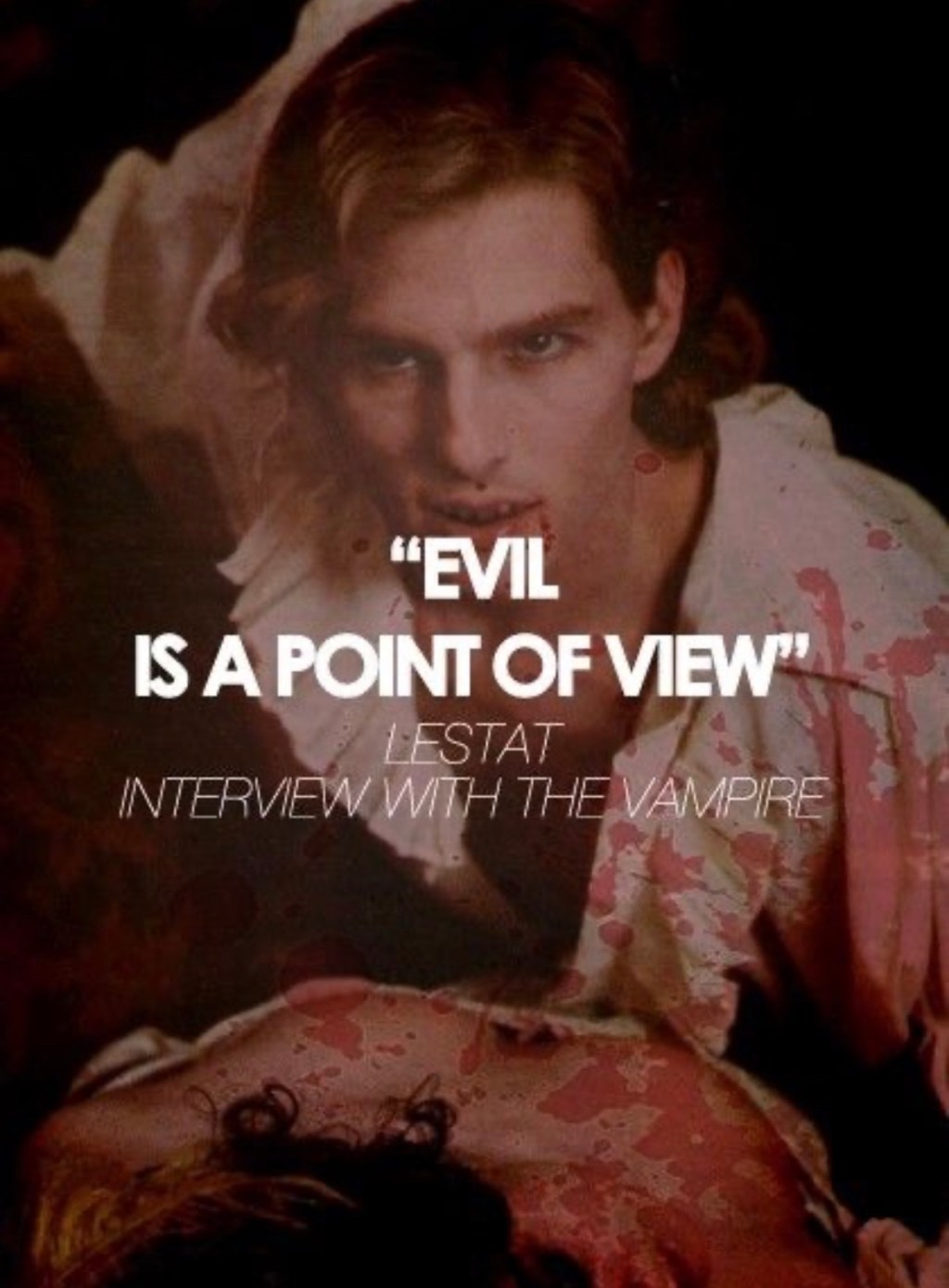
What makes one evil? “Evil is a point of view… God kills indiscriminately, and so shall we.” (Anne Rice, Interview With The Vampire, 1976) Well, in real life, that is simple, “harm none, do as ye will” (the Wiccan rede). In fiction, it is complicated. In the first three Vampire Chronicles by Anne Rice, the characters are evil, without question. They are vampires and take life; not a single one is good. That does not mean they the vampires see it that way. Also they all view good and evil differently. Evil in fiction is complex and multilayered; this is shown through Louis de Pointe du Lac and (his and Lestat’s daughter Claudia) Nicolas de Lenfent, Armand of Kyiv, Queen Akasha, and Lestat de Lioncourt all have different philosophies and different perspectives on the nature of good and evil. All the vampires except Lestat de Lioncourt are cynical, brutal or are thoroughly disconnected from their previous humanity.
Louis de Pointe du Lac (“merciful death”), the human vampire with a soul who is also brutal, monstrous and parasitic. Louis is a plantation owner from the 18th century whose very existence is parasitic, both as an enslaver and a vampire. Nevertheless, he feels, and strongly, most often Roman Catholic guilt. “Lestat must have wept when he made you.” (Anne Rice, Interview With The Vampire, 1976) One could simplify his sadness as merely brooding, but if one reads between the lines, it is far deeper than that. How does one live with oneself if one is a monster? How does one live with yourself if your contract to unlife (preternatural) is signed in the blood of others? Despite this, Louis is the most indiscriminate and brutal vampire, as he destroys the Theatre des Vampires and drinks from Claudia, an innocent plague victim. Claudia, by contrast, essentially borrows from both her fathers, Lestat and Louis. She uses Louis because he is easy to manipulate, but she is a child with bloodlust. She also does not hesitate to slit Lestat’s throat when it serves her, and though it costs her immortal existence, she is a brutal killer, as ‘parasitic’ as Louis, and shares Lestat’s lack of shame and revels in the kill. “She pursued blood in all a child’s demanding.” (Anne Rice, Interview With The Vampire, 1976) Claudia despite her doll-like visage, has a lust for blood and revels in the kill, she’s also as parasitic as Louis de Pointe du Lac, her favoured father.
Nicolas de Lenfent, a violinist from the Auvergne, and Lestat’s first male lover that we know of. The case of unrepentant evil. Nicolas, like Louis, is a cynic who suffers Roman catholic guilt; however, he is fundamentally angry and bitter unlike Louis who is sad, quiet and resigned. He is simply being what he has no choice but to be. To Nicolas, goodness and virtue are unattainable and a fallacy, so, to push against his cage and, by extension, his catholic guilt, he becomes the devil’s tool himself. “If goodness does exist, I am the opposite of it, and I revel in it.” (Anne Rice, The Vampire Lestat, 1985) To Nicolas, this is not ‘evil’ as much as it lashes out angrily at a system that despises him and as such has revoked his personhood and free will.
Armand of Kyiv, the auburn haired black-winged angel, a victim of sexual abuse and emotional violence who was ripped from his homeland of Ukraine as a teenager (at the time the Kyivan-Russ). He is a case of a broken person breaking others in return. He is not evil, just hurt and traumatized. On himself, he says, “If I am an angel, paint me with black wings.” (Anne Rice, The Vampire Armand, 1998). Nevertheless, like all Ricean vampires, he is more than capable of love, even though, in his case, it is the unhealthy obsessive sort we see with Daniel Molloy and The Devil’s Minion in The Queen of the Damned.
Akasha; the Queen of all vampires. She never wanted to be a vampire. Even in life as a Queen she is not ‘good.’ In her case, she is a case of a perversion of justice, anger, and control. Despite Akasha’s good intentions, she ends up attempting genocide on half the male population; she thinks she is serving humanity but is not; she is angry and has lost control. She believes she is doing justice, but it’s simply an excuse to justify her parasitic existence. For all vampires take life, and that makes them immoral. “And what constitutes evil, real evil, is the taking of a single human life.” (Anne Rice, Interview With The Vampire, 1976 ). Though Akasha’s anger is justified, to an extent. Sexism and violence against women is still statistically high. Two wrongs do not make a right. Except for Lestat, Akasha views men as burdensome, inherently violent and she thinks removing half of all mortal men from existence will solve the underlying societal problem. In The Queen of the Damned she tries to compel Lestat to massacre a village. Lestat for all he revels in being in danger and being ‘bad’ is repulsed. Akasha and Lestat’s monstrous love raises the questions of, what’s the line between humanity and monstrosity? How do I justify my existence if I take life? How do we live with the alienation and monstrosity of our vampirism and exitstence? Akasha, is a fascinating, compelling and deeply philosophical antagonist, but as all vampires are she is amoral.
Last but certainly not least, the Brat Prince, Lestat de Lioncourt. Lestat, at his core, believes in goodness, optimism, and persistence. Even as a human, he fundamentally believes in goodness and wants to do ‘right’ by those around him. He takes down a pack of wolves attacking his village in the Auvergne earning him the title “Wolfkiller” as well as catches hares to keep his family fed, despite his intense dislike of his father and siblings. Upon being turned into a vampire, he laments, “I am an unwilling devil, I cry like some vagrant child, I want to go home.” (Anne Rice, The Vampire Lestat, 1985) Nicolas and Akasha even call him on his belief in goodness and what they see as foolishness, and he still presses on. Like a Shakespearean hero, he keeps going and pushes forward against all odds. “In the end, we must suffer through this loneliness, this emptiness and find what impels us to continue.” (Anne Rice, The Vampire Lestat, 1988) Lestat de Lioncourt despite his ongoing existential crisis, and vampiric monstrousness and facade of Bratiness he still has a conscience, a willingness to keep going and a belief in goodness and his good intentions that is integral to his character.
In closing, good and evil in Anne Rice’s The Vampire Chronicles are complex and grey, and we should normalize that in fiction. As we have seen, evil is evil, but even evil comes in shades. Lestat de Lioncourt is the most human of the amoral yet very human vampires of Anne Rice. Anne Rice wrote her bi vampires to make people feel seen, and while vampires are immoral, I am forever grateful for that. “The only power that exists is within ourselves,” Anne Rice once said. We should value the nuance in fiction and, in our real lives, endeavor to be as good as we can be. Let us be good for goodness sake.
Works Cited
- Jones, Rolin, creator. Interview With The Vampire (2022). AMC.
- Jordan, Neil, director. Interview With The Vampire (1994).
- Rice, Anne. Interview with the Vampire. Alfred A. Knopf, 1977.
- Rice, Anne. The Queen of the Damned. Little, Brown Book Group Limited, 1990.
- Rice, Anne. The Vampire Armand. Alfred A. Knopf, 1998.
- Rice, Anne. The Vampire Lestat. Knopf, 1985.


Leave a reply to Meera • Desi Vampire Princess Cancel reply