


the necessity of the dark and remembering that the only power that exists is within ourselves
Alternatively titled: Anne Rice and the fallacy of acting well enough to be ‘one of the good ones’
Warning, not a content warning an idea has only as much power over you as you permit it to, none of these ideas alone can harm you unless you give them that power, however, for those of the faint of heart I will be discussing: Catholicism, catholic guilt, PTSD (fictional and otherwise), CSA/SA (fictional and otherwise) the process by which humans other one another and the harm it does to those deemed ‘other,’ history, historiography (European and global majority meaning Jewish and BIPOC), the Haitian Revolution, the French Revolution’s reign of terror and the man made ignorance compounding the logic of guillotine and for that matter any state sanctioned death penalty or murder, vampiric or otherwise. Historical and present violence against women, misogyny, gender roles, biphobia (bisexual erasure, transphobia, monosexim, binarism), philosophy, existentialism, nihilism, hedonism, BDSM/kink culture, as I am a goyim and keenly aware my privilege being a goy, as was our late great Lady Anne Rice, antisemitism, in passing and with respect to its at least 6 million Jewish victims, the Spanish Inquisition, empire as exemplified by the ancient Romans, the Ottomans and Europeans globally but especially the French and English, and most crucially the imperative of being yourself and the necessity of chasing down the dark so you may remember your own inner light.
“Evil is a point of view. God kills indiscriminately and so shall we. For no creatures under God are as we are, none so like him as ourselves.” – Lestat de Lioncourt, Interview With The Vampire novel (1976) by Anne O’ Brien Rice
“Believe me, Eugenie, the words “vice” and “virtue” supply us only with local meanings. There is no action, however bizarre you may picture it, that is truly criminal; or one that can really be called virtuous. Everything depends on our customs and on the climates we live in. What is considered a crime here is often a virtue a few hundred leagues away; and the virtues of another hemisphere might, quite conversely, be regarded as crimes among us. There is no atrocity that hasn’t been deified, no virtue that hasn’t been stigmatized.” – La philosophie dans le boudoir (Philosophy in the Boudoir) (1795) by Donatien Alphonse François de Sade (1740-1814)
“Can we become other than what we are?” – Donatien Alphonse François de Sade (1740-1814)
“None of us really changes over time. We only become more fully what we are.” – Lestat de Lioncourt, The Vampire Lestat novel (1985) by Anne O’ Brien Rice




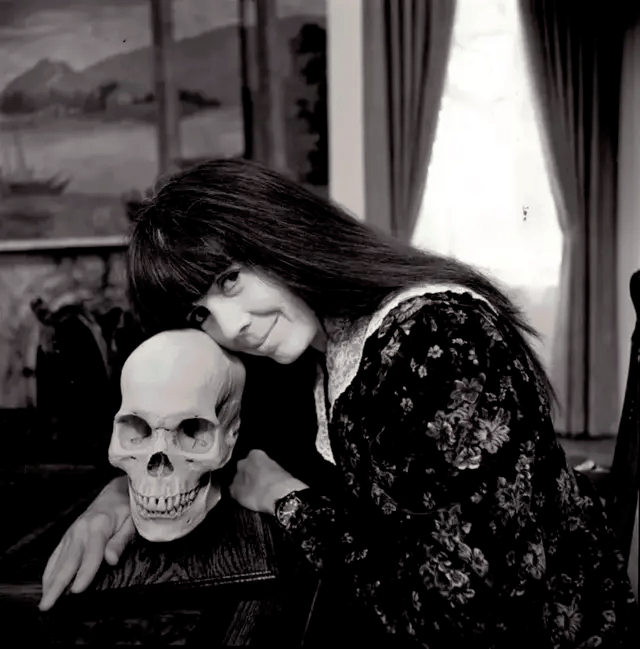
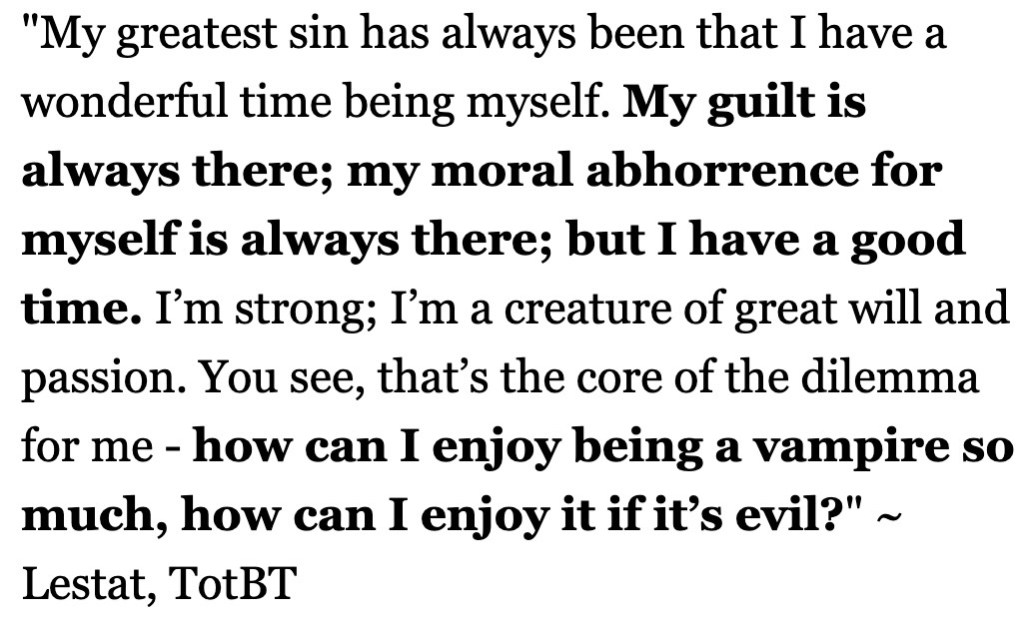
“In the name of Christ, I refuse to be anti-gay. I refuse to be anti-feminist. I refuse to be anti-artificial birth control. I refuse to be anti-Democrat. I refuse to be anti-secular humanism. I refuse to be anti-science. I refuse to be anti-life. In the name of Christ, I quit Christianity and being Christian. Amen.”
Anne Rice, on her Facebook page, July 28, 2010 (source)
I shall address the at least 5’10 (not bad for the 18th century), gorgeous but deeply existential vampire in the room, as he is rather tall, and although pleasant to look at, he is still a vampire, therefore an outsider, no matter how much he clings to his humanity he is after all, still a killer many times over per his condition as a vampire; something preternatural, and a being committed to evil depending upon who you ask. We are all going to die, sooner or later, and whilst memento mori is important to keep in mind, memento vivere (remember to live) is as important, if not more so, important to keep in mind.
Further, No group deemed ‘deserving’ of their status as an ‘other’ by those in power, deeming them ‘worthy’ of being ‘other’, whether it be bisexuals/biromantics, individuals in the BDSM culture/kinksters/leather daddies, asexuals and aromantics, gender non-conforming people (the vast majority of whom are also bisexual) from broader cisheternormative society and within the LGBT community, Jewish people for the entire history of Judaisms long history especially under the Ancient Roman Empire, racialized people whether it is anti-blackness or orientalism, to authors of ‘contentious’ fiction, to anyone who gives dissent to the status quo, to women in history who are deemed ‘too loud’ ‘too unusual’ and ‘too sexual’ for daring to do exactly as their male peers do. Not a single one of them ‘deserves’ to be stripped of their free will and, crucially, their humanity. Not just because the action of deeming one ‘inhuman’ is how the Haitian Revolution happened, prompted by necessity pushed by Bonaparte and other Europeans’ intent to destroy completely, as well as to reinstate slavery in Haiti. Of course, it is how the multiple Spanish Inquisitions were justified and the Holocaust enacted by the Third Reich, as Jewish people are intimately familiar with, as well as the ‘logic of guillotine’ and choosing ‘terror’ to justify alleged ‘virtue,’ though of course the vast majority of those deemed ‘other’ understand that, it is the basis of ‘be gay (lgbt+ or queer) do crime!’ but, as Angela Carter not wrongly in her nonfiction book of essays, The Sadeian Woman and the Ideology of Pornography (1978), “Sade’s heroines, those who become libertines, accept damnation, by which I mean this exile from human life, as a necessary fact of life. This is the nature of the libertine. They model themselves upon libertine men, though libertinage is a condition that all the sexes may aspire to. So Sade creates a museum of woman-monsters,” in the preface. Further, in that same preface, she observes, not lacking historical or fictional evidence, “A free woman in an unfree society will be a monster. Her freedom will be a condition of personal privilege that deprives those on which she exercises it of her own freedom. The most extreme kind of this deprivation is murder. These women murder. The sexual behaviour of these women, like that of their men, is a mirror of their inhumanity, a magnified relation of the ambivalence of the word ‘to fuck’, in its twinned meanings of sexual intercourse and despoliation: ‘a fuck-up’, ‘to fuck something up’, ‘he’s fucked’.” Not without philosophical grounds, Angela Carter observes pointedly, that to take another human being’s life is the ultimate form of mutual dehumanization. If every Sadeian heroine is a murderer, gaslighted into it or not or a woman who ‘fucks’ rather than ‘be fucked’, I think it is more than reasonable to assert all Anne Rice characters are libertines, in the tradition of transgressive French anti-hero (or villain) like de Sade and his contemporary and frenemy, de Laclos. Of course, they are all incredibly Byronic as well, and though perhaps Rice didn’t intend it, written for the most part like Shelley and Byron, that is to say, capital R Romantics.
Yet still, we, the reader, know Louis de Pointe du Lac, Lestat de Lioncourt, Rowan Mayfair and even Quinn Blackwood could drag us into the darkness pervading their lives either because of their vampirism or because they must face the dark every night, and as Lestat exemplifies, it is only his ray of sunlight within. The altogether brave ability to see goodness in others and a stubborn altruism that seems largely absent from the fictional and real world now that keeps golden-haired, grey-blue-eyed Brat Prince, the vampire Lestat de Lioncourt, going. We do not come to fiction, whether it be Lestat, Rowan, Juliette or Mary Shelley’s 1818 novel Frankenstein, to learn moral lessons; that is the business of fables and children’s stories. We seek them out because he expects nothing from us, holds no moral authority over us or anyone else and because he is as much an outsider as we are. After all, everyone is a monster to someone, and it is well understood by marginalized people, no matter how much you attempt to bend to your oppressors to be ‘one of the good ones.’ You never will be. So you may as well seek sanctuary with other outsiders.
Anne Rice understood this. She lived it. From dropping Howard for Anne. To her advocacy for LGBT people, especially bisexuals and individuals queering gender, to taking the Catholic church to task for their still ongoing enabling of sexual assault, sexual abuse of children and violence against women. To depict black folks in New Orleans, Louisiana, in the 1840s with such empathy and humanity in the historical fiction novel The Feast of All Saints, fighting Catholic antisemitism from her very own peers, and more. Her refusal to be quiet to ‘be fucked’ and to stay silent is why she is beloved by so many. Not simply the vivid pictures, characters, and worlds she spun us. Worlds that show us our own inner light and say, softly, sometimes with leather and lace, with fangs, through a blonde androgynous lady Doctor who is far smarter than any man in her presence and who has sex with any man (and probably women and gender diverse person) she wants. In refusing to be categorized and through being only ever herself, Anne Rice says to us, ‘Hey, remember you are not alone here.’ Indeed, even Jane Austen and Mary Shelley in the 1810s gained a hint of controversy for showing through their lived experience and literary works, “A woman, especially if she has the misfortune of knowing anything, should conceal it as well as she can.” and further, “I hate to hear you talk about all women as if they were fine ladies instead of rational creatures. None of us wants to be in calm waters all our lives.” Anne Rice had the misfortune and gift of being a woman who knew things, and for having the ‘unladylike’ nerve to listen and conceive perfectly well of her own humanity in all the messiness and at times grief that is the human condition.
Works Cited
Aromanticism.org, https://www.aromanticism.org/en/resources-1.
“ANNE RICE, An All Saints’ Day Celebration.” Anne Rice, https://annerice.com/. Accessed 3 November 2025.
anonymous. “Against the Logic of the Guillotine: Why the Paris Commune Burned the Guillotine—and We Should Too.” The Anarchist Library, https://theanarchistlibrary.org/library/crimethinc-against-the-logic-of-the-guillotine. Accessed 3 November 2025.
anonymous. “Be Gay Do Crime: The Secret History of This Viral Slogan.” The Brain Blog, 2025. https://the-brain.blog/be-gay-do-crime-secret-history-viral-slogan-7171/. Accessed 3 November 2025.
“Antisemitism Education – Jewitches.” Jewitches, https://jewitches.com/en-ca/pages/antisemitism-education. Accessed 3 November 2025.
Ashley, and Joel. “”‘Poked At’ Was the Wrong Thing to Say There, Wasn’t It?” | Anne Rice Biographical Discussion | The Articulate Coven.” Articulate Coven, https://articulatecoven.com/episode/poked-at-was-the-wrong-thing-to-say-there-wasnt-it-anne-rice-biographical-discussion-the-articulate-coven.
The Bay Area Bisexual Network. “Fully transcribing The Bisexual Manifesto from: Anything That Moves: Beyond the Myths of Bisexuality (1990).” 1990. https://bimanifesto.carrd.co/. Accessed 3 November 2025.
The Bisexual History Archive. Bi History, Mel Reeve, https://bihistory.com/archive-atlas/. Accessed 3 November 2025.
Carter, Angela. The Sadeian Woman. Harper Colophon Books, 1980. Accessed 3 November 2025.
CBC. “Anne Rice used vampires to show people they belong, says son.” CBC, 14 December 2021, https://www.cbc.ca/radio/asithappens/as-it-happens-the-monday-edition-1.6284012/anne-rice-used-vampires-to-show-people-they-belong-says-son-1.6284014. Accessed 3 November 2025.
de Sade, Marquis. Philosophy in the Bedroom. CreateSpace Independent Publishing Platform, 2015. Accessed 3 November 2025.
Eisen, Yosef. “The Spanish Inquisition.” Chabad.org, https://www.chabad.org/library/article_cdo/aid/2430792/jewish/The-Spanish-Inquisition.htm. Accessed 3 November 2025.
Heydrich, Reinhard, and Ernst Kaltenbrunner. “Glossary | Holocaust Encyclopedia.” Holocaust Encyclopedia, https://encyclopedia.ushmm.org/content/en/article/glossary. Accessed 3 November 2025.
Hoover, Lisa. “Banned Author Anne Rice Dies, Leaving Legacy that says it’s OK to Struggle.” Intellectual Freedom Blog, 16 December 2021, https://www.oif.ala.org/banned-author-anne-rice-dies-leaving-legacy-that-says-its-ok-to-struggle/. Accessed 3 November 2025.
Iovine, Anna, and anna iovine. “Bisexual zine ‘Anything That Moves’ is relevant 30 years later.” Mashable, 4 October 2022, https://mashable.com/article/anything-that-moves-bisexual-zine. Accessed 3 November 2025.
“Links and Resources Masterpost – Visibility and Education Projects – Asexual Visibility and Education Network.” The Asexual Visibility and Education Network, 17 March 2012, https://www.asexuality.org/en/topic/72195-links-and-resources-masterpost/. Accessed 3 November 2025.
Marshall, Kravatz. “The Bisexual History They Don’t Want You to Know.” 2020. Medium, https://medium.com/an-injustice/the-bisexual-history-they-dont-want-you-to-know-467ab6fb43ee. Accessed 3 November 2025.
Marshall, Kravitz. “The Anti-Binary Power of Bisexuality.” 2020. Medium, https://medium.com/an-injustice/bisexuality-is-inherently-nonbinary-d1f75d729e78.
Rice, Anne. “creating the Vampire Lestat.” YouTube, Anne Rice, May 5 2010, https://www.youtube.com/watch?v=jr5HN__jrNY. Accessed 3 November 2025.
Rice, Anne. The Feast of All Saints. Random House Publishing Group, 1986. Accessed 3 November 2025.
Rice, Anne. Interview with the vampire. Random House Publishing Group, 1997. Accessed 3 November 2025.
Rice, Anne. Interview with the Vampire: Claudia’s Story. Yen Press, 2012. Accessed 3 November 2025.
Rice, Anne. “Lestat’s philosophical studies.” YouTube, Anne Rice, 5 May 2025, https://www.youtube.com/watch?v=JbQjvndx1dA&list=PL133614310A1ADFAE&index=4. Accessed 3 November 2025.
Rice, Anne. “the modern vampire.” YouTube, Anne Rice, 7 May 2010, https://www.youtube.com/watch?v=9JuRY-dpM88. Accessed 3 November 2025.
Rice, Anne. The Mummy. Arrow Books, 2004. Accessed 3 November 2025.
Rice, Anne. The Vampire Chronicles. Alfred A. Knopf, 2012. Accessed 3 November 2025.
Rice, Anne. The Vampire Lestat. Random House Publishing Group, 1986. Accessed 3 November 2025.
Rice, Anne. The Witching Hour. Arrow Books, 2004. Accessed 3 November 2025.
Rice, Anne. The Wolf Gift. Knopf Doubleday Publishing Group, 2013. Accessed 3 November 2025.
Rice, Anne. The Wolves of Midwinter: The Wolf Gift Chronicles (2). Knopf Doubleday Publishing Group, 2013. Accessed 3 November 2025.
Rice, Anne, and Christopher Rice. Ramses the Damned: The Passion of Cleopatra. Knopf Doubleday Publishing Group, 2017. Accessed 3 November 2025.
Rice, Anne, and Christopher Rice. Ramses the Damned: The Reign of Osiris. Knopf Doubleday Publishing Group, 2022. Accessed 3 November 2025.
Rice, Cristopher, and Eric Shaw Quinn. “Ep. 308 – AnneCast Vol. 6 – Anne Rice: In Her Own Words.” The Dinner Party Show, The TDPS Network, 1 November 2025, https://thedinnerpartyshow.com/. Accessed 3 November 2025.
Sexsmith, Sinclair. “Kink 101: Books, Websites, and Other Resources for Someone New to Kink.” sugarbutch.net, https://www.sugarbutch.net/2021/05/kink-resources/. Accessed 3 November 2025.
Shelley, Mary. Frankenstein: The 1818 Text. Penguin Publishing Group, 2018. Accessed 3 November 2025.
“Slavery and the Haitian Revolution.” Liberte, Egalite, Fraternite: exploring the French Revolution. https://revolution.chnm.org/exhibits/show/liberty–equality–fraternity/slavery-and-the-haitian-revolu.
“Vampire queen Anne Rice’s fans to gather in New Orleans for a memorial celebration.” Nola.com, https://6strip4you.com/entertainment_life/anne-rice-new-orleans-memorial/article_2bee59b3-3c2b-4d5f-8283-1af713af288f.html. Accessed 3 November 2025.
Wells, Carlie Kolath. “”I want to be immortal”: Anne Rice’s fans honor her legacy in New Orleans.” MSN, 2 November 2025, https://www.msn.com/en-us/tv/celebrity/i-want-to-be-immortal-anne-rice-s-fans-honor-her-legacy-in-new-orleans/ar-AA1PFYbQ. Accessed 3 November 2025.

Leave a comment